The 20th G20 meeting was the first to be held on African soil. It took place in Johannesburg in November 2025 under the South African presidency. In the African spirit of Ubuntu (I am because we are), states acknowledge that individual states cannot thrive in isolation. It was the first meeting since the admission of the African Union as a permanent G20 member, in 2023, strengthening Africa’s collective voice in global economic governance.
However, while the summit helped recentre discussions around the needs and perspectives of developing economies, leaders of several major economies were missing, notably the United States, Russia and China.
South Africa’s 2025 Think 20 Process
Under the leadership of South Africa’s 2025 G20 presidency, the policy engagement group, the Think 20 (T20) was coordinated by the Institute for Global Dialogue (IGD), South African Institute of International Affairs (SAIIA), and Institute for Pan-African Thought and Conversation (IPATC).
In early 2025, the T20 South Africa launched a global call for abstracts, inviting researchers to contribute to high-impact policy briefs aligned with five priority task forces:
- Trade and Investment
- Digital Transformation
- Financing for Sustainable Development
- Solidarity for the Achievement of the SDGs
- Accelerating Climate Action and the Just Energy Transition
The response was overwhelming, with over 800 abstracts submitted by researchers worldwide. Of these, approximately 125 were selected for development as full policy briefs.
Through expert insights and bold recommendations, the T20 South Africa policy briefs offer concrete proposals to close some of the most pressing gaps in global economic governance.
Policy briefs focusing on Special Drawing Rights (SDRs)
Four policy briefs focused on SDR reform.
- Reforming SDR Allocation Criteria to Enhance Its Role in Global Crisis Response and Sustainable Development Financing
Proposes shifting from quota-based allocations to a needs-based approach, incorporating indicators of financial vulnerability and development needs. This would enable SDRs to better support countries during crises and development transition. - Fixing the Foundations: G20 Priorities for Equitable IMF Transformation
Argues for decoupling SDR allocations from IMF quotas and advocates for a reform that turns SDRs into a central tool for equitable global liquidity. - The Future of African Development: Strengthening African Financial Institutions for Sustainable Growth and Development
Highlights the strategic role of African Financial Institutions (AFIs) in ensuring debt sustainability and long-term development. The brief recommends that AFIs like the African Development Bank (AfDB) be granted prescribed holder status for SDRs, allowing them to receive and leverage unused SDRs by up to fourfold to support regional development priorities. - The Potential for SDRs and Reducing Outflows on SDG Progress
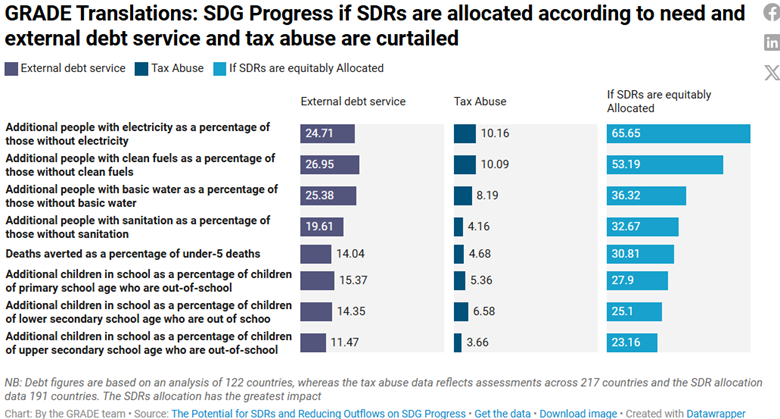
Also suggest decoupling from IMF quotas and go further by quantifying the potential of reallocating SDRs based on need (e.g., inverse of GDP per capita) on economic and social rights using the GRADE tool. The brief highlights the enormous potential of SDR reallocation based on need, but for these efforts to be sustainable, reforms to the international tax system, reduction of harmful tax exemptions, and provision of comprehensive debt relief are also essential (Figure).
These proposals were reflected in the T20 Final Communiqué, which urged G20 leaders to support transforming SDRs into “a central pillar of a revived global financial safety net.”
The final G20 122-paragraph Leaders Declaration reaffirmed their commitments to ensuring that global financial flows support investment in sectors where sustainable fiscal space is key, including education, health, and social protection, sectors where sustainable fiscal space is critical. Leaders also stated that
“We acknowledge the importance of realignment in [SDR] quota shares to better reflect members’ relative positions in the world economy while protecting the quota shares of the poorest members” (para 56).
If the G20 acts on their commitments to support investment in sectors such as health and education and their acknowledgement of the importance of the realignment of quotas, SDRs could evolve from an underutilized reserve asset into a powerful lever for sustainable development.